Cost · Guide
What Drives the Cost of a Covered Patio in DFW
We are not going to put a fake number on a web page. We will tell you exactly what moves it, in order.
Every contractor site has a page with a number on it, and every one of those numbers is close to meaningless — because the honest range across the projects we actually build spans a factor of five or more.
What is genuinely useful is knowing what moves the number. Here it is, roughly in order of impact.
1. Footprint, and it is not linear
Square footage is the biggest single driver, and doubling the size costs more than double. A longer span needs deeper beams, deeper beams need bigger posts, and bigger posts need larger footings. Every dimension pushes on the next one.
This is why we push back on "let's just make it a little bigger" late in design. It is rarely a little more money.
2. Roof complexity
A single shed plane tying into an existing eave is the simplest and least expensive roof we build. From there:
- Gable costs more — more framing, more cuts, more roofing.
- Vaulted with an exposed truss costs more still, because the truss is cut and fitted rather than ordered.
- Multiple planes tying together is the most expensive, because every valley is a flashing detail and every intersection is where water finds problems.
Complexity is also where craftsmanship shows most. It is a legitimate place to spend money — just spend it knowingly.
3. Ceiling finish
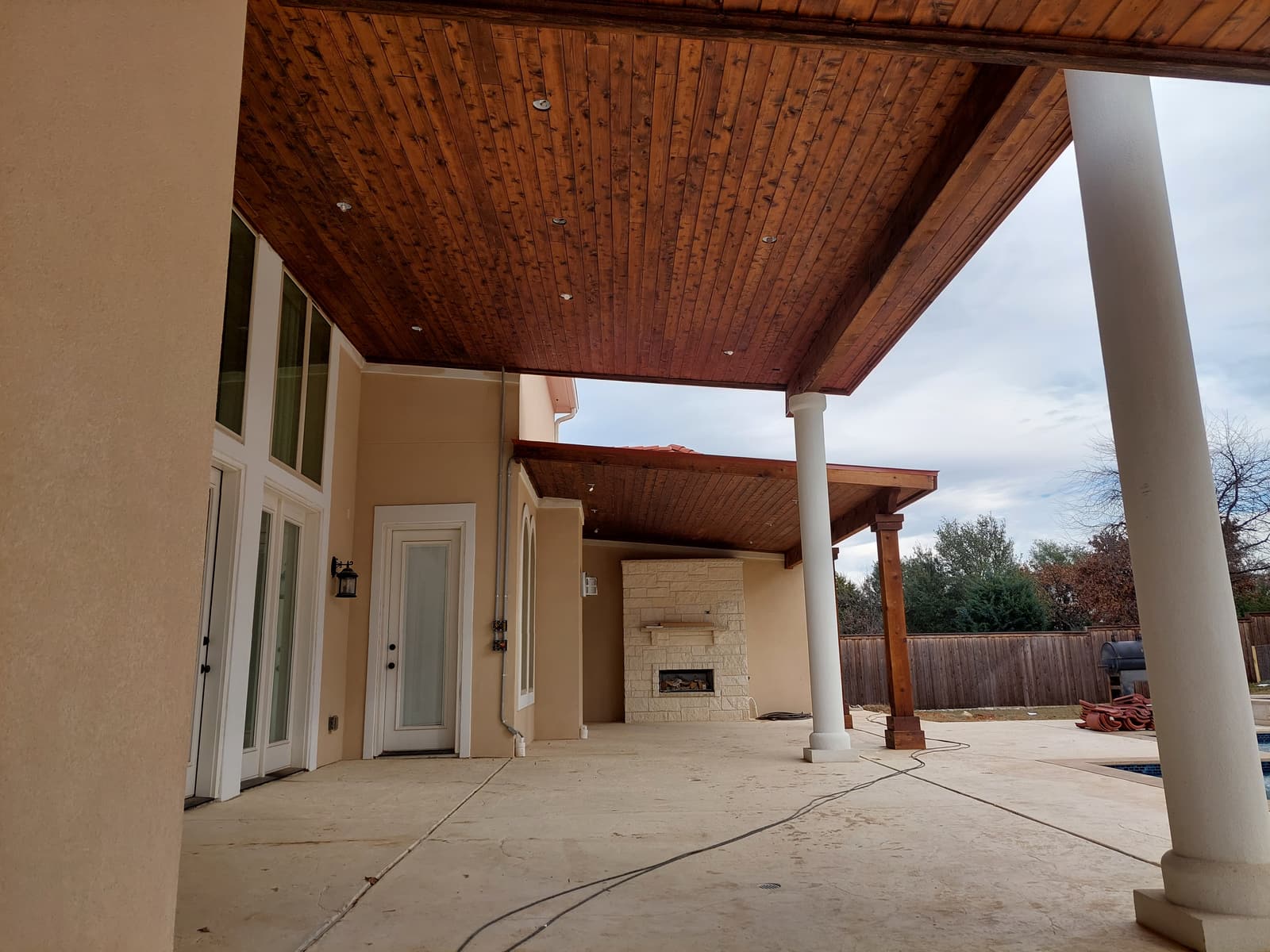
Exposed framing costs least. A painted soffit costs more. Stained cedar tongue-and-groove costs most of the three, and it is the thing people are happiest with by a wide margin.
If you have a fixed budget and you are deciding where it goes, we would put it here before we put it into stone columns. The ceiling is what you look at from the chair.
4. The tie-in to your house
Straightforward eave connections are routine. What raises cost:
- Cutting into the existing roof rather than tying under the eave
- A second-story wall connection
- Windows or doors in the way of where posts or the ledger need to land
- An existing roof that is at the end of its life and should be addressed first
That last one is worth naming. If your shingles have three years left, tying a new structure into them and re-roofing in three years costs more than sequencing it the other way around. We will tell you if we see it.
5. Slab work
Building over sound existing concrete is the least expensive path — we core-drill for footings and the slab becomes your floor. Costs rise if you need a new pour, an extension, or if the existing slab is failing and needs removal.
6. Electrical, gas and finish work
Fans, recessed lighting, outlets, switching, TV rough-in, speakers, gas stubs, heaters. Individually modest, collectively significant.
Our strong advice: rough all of it in now even if you install some of it later. Running a gas line to a stub while the framing is open is inexpensive. Adding one after a cedar ceiling is closed means opening the ceiling.
7. Site access
If a truck can back up to the build, it costs less than if every board, bag of concrete and sheet of roofing gets carried through a 36-inch side gate. On tight urban lots this is a real line item, and it is invisible until somebody points it out.
8. Extras
Stone columns, an outdoor kitchen, a fireplace, motorized screens, a hot tub deck. These are genuine additions rather than cost drivers of the structure itself, and they are the easiest place to phase.
Where we would save, and where we would not
Reasonable places to save: a simpler roof form, shingles matched to the house rather than standing-seam metal, phasing the outdoor kitchen for later, fewer stone columns, building over the existing slab rather than pouring new.
Places we would not save:
- Footing depth. Especially on Collin County clay. This is not the line to trim.
- Flashing at the tie-in. Water in a wall is the most expensive mistake on this list, by a lot.
- Electrical rough-in. Cheap now, expensive forever after.
- Cedar on visible members. See our material comparison — twisted rafters do not untwist.
How we quote
We walk the space, ask what you actually want to do out there, and give you one fixed, itemized number in writing. Everything included is on the page. If something genuinely changes mid-build — we open a wall and find rot nobody could have known about — we tell you before we do anything, not after.
No range. No "starting at." No number that grows in month two. Have us out and find out what yours actually is.
Questions people ask
What is the biggest cost driver on a covered patio?
Footprint, and it does not scale linearly — a longer span needs deeper beams, which need bigger posts, which need larger footings. Roof complexity is second, and ceiling finish is third.
Where can I save money on a covered patio without regretting it?
A simpler roof form, shingles matched to the house instead of standing-seam metal, phasing an outdoor kitchen for later, fewer stone columns, and building over sound existing concrete. What we would not trim is footing depth, tie-in flashing, electrical rough-in, or cedar on visible members.
How should I compare two patio cover bids?
Ask both builders four questions: how deep are the footings and how was that determined, how is the roof tie-in flashed, what species are the visible members, and is the finish applied before handoff. A large price gap almost always lives in one of those answers.
Keep Reading
Related from the journal
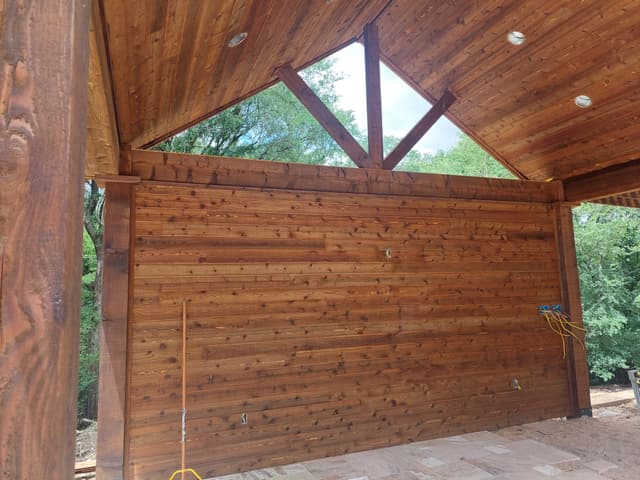
Cedar vs. Pressure-Treated Pine: What We Use and Why
One of these twists as it dries and one does not. That single difference decides most of the argument.
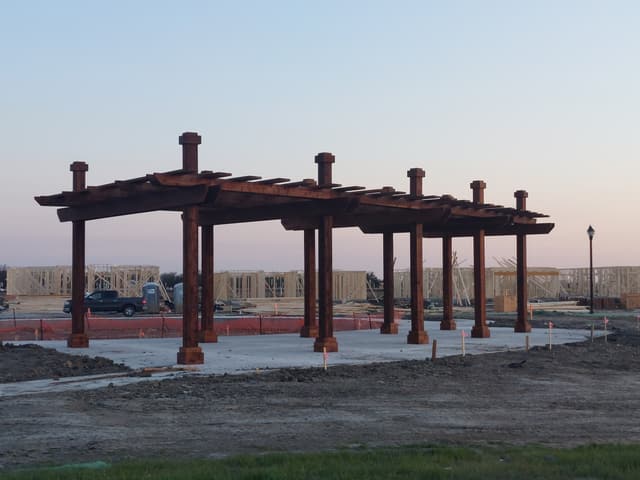
Do You Need a Permit for a Pergola in DFW?
Usually yes. Always if it attaches to the house. And the HOA is a separate process from the city — here is how both actually work.
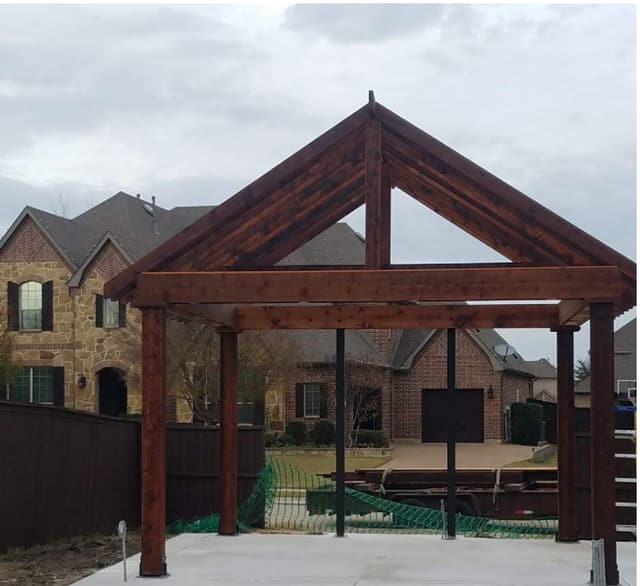
Pergola vs. Patio Cover vs. Pavilion: Which One Do You Actually Want?
People come to us asking for one and often want another. Here is how to tell the difference before you spend money.
Free Estimates
Tell us what you want to build.
Nathan will walk your yard, talk through what will actually work, and give you a written number. It costs nothing and there is no obligation on the other side of it.