Common Questions
Straight answers.
The things people ask before they call, answered without hedging.
General
Working with us
Do you charge for an estimate?
No. Nathan comes out, walks the space, talks through what will actually work, and gives you a written itemized bid at no cost and with no obligation.
How far out are you booking?
It varies with the season — spring and early summer are the busiest. We give you a real start date when we bid rather than a vague window, and we hold to it.
Are you licensed and insured?
We carry general liability and workers compensation insurance, and we provide certificates on request. Texas does not license general contractors at the state level, but all electrical, plumbing and gas work on our jobs is performed by licensed trades and permitted.
Do you offer financing?
We do not finance in-house. Most clients use a home equity line or a home improvement loan, and we are happy to provide the documentation a lender asks for.
What areas do you serve?
The Dallas–Fort Worth metroplex — Fort Worth, Arlington, Plano, Frisco, McKinney, Southlake, Keller, Mansfield, Grapevine, Denton and the surrounding communities. If you are not sure whether you are in range, call and ask.
Do you do commercial work?
Yes. Heavy-timber pergolas, amenity pavilions, mail kiosks and community docks for developers, HOAs and property managers. We build to stamped drawings and provide certificates of insurance, W-9s and lien waivers on your standard forms.
Do you warranty your work?
Yes — we stand behind our workmanship, and manufacturer warranties pass through on materials like roofing and composite decking. Terms are on the contract in plain language, not buried in fine print.
Can you work with my landscaper, pool builder or concrete contractor?
Regularly, and it usually produces a better result. Sequencing matters — a pergola built before the concrete is poured is a different job than one built after. Get us all talking early.
Pergolas
About pergolas
How long does a custom pergola take to build?
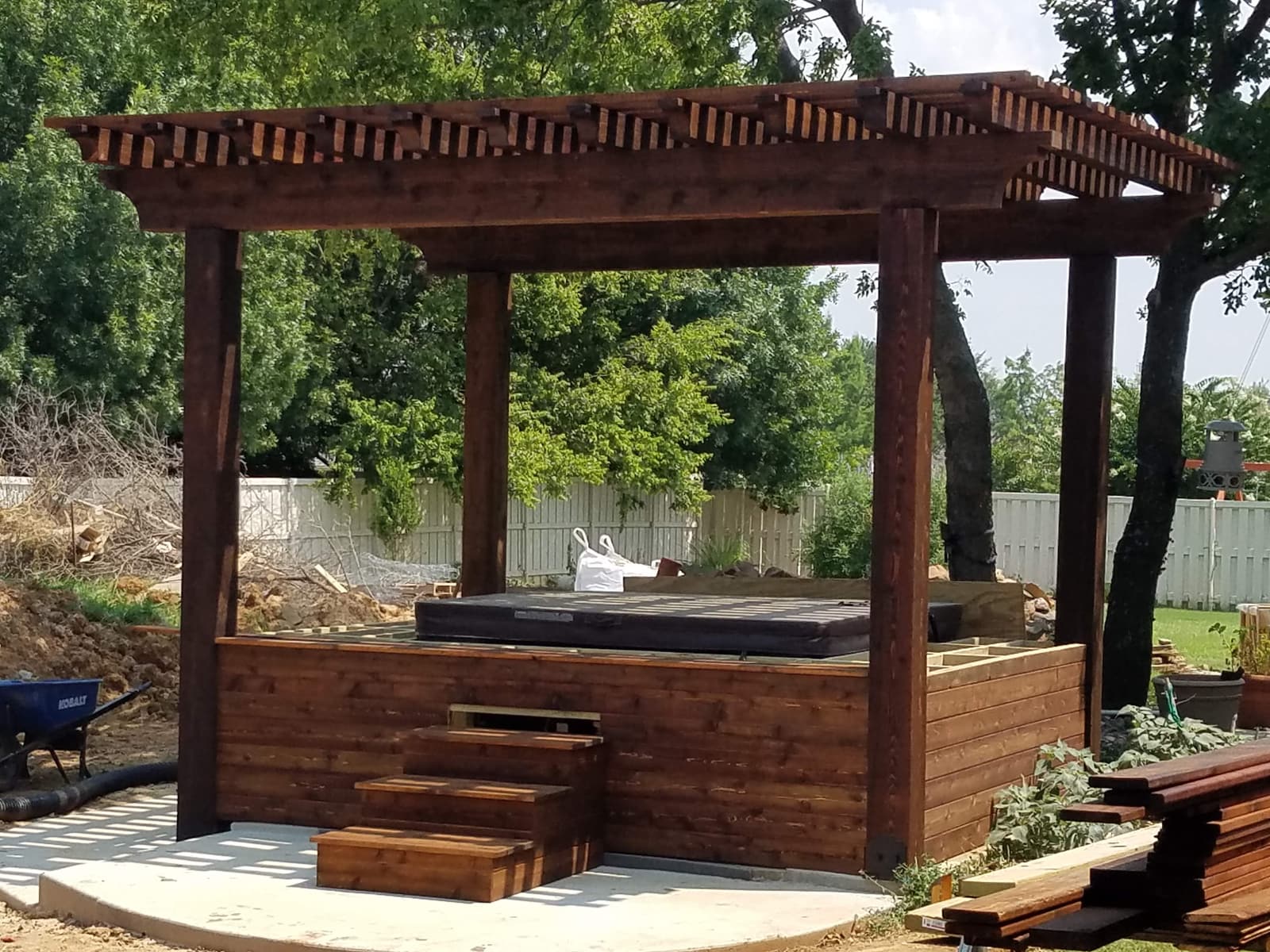
Most residential pergolas are a three to five day build once we start. The longer part is what comes first: design, the written bid, and the permit, which in most DFW cities runs one to three weeks. We give you a start date, not a season.
Do I need a permit for a pergola in Texas?
Usually yes, and always if it attaches to the house. Most DFW cities require a permit for any structure over a certain footprint, and HOAs almost always require separate architectural approval. We handle the city permit as part of the job and give you the drawings you need for the HOA packet.
Cedar or pressure-treated pine?
Cedar, for anything you will look at every day. It is naturally rot and insect resistant, it stays straight instead of twisting as it dries, and it holds stain beautifully. Treated pine costs less up front and is perfectly good for framing you will never see — but it moves as it dries, and a twisted rafter is a twisted rafter forever.
Will a pergola stand up to North Texas wind and hail?
Ours do. Post size, footing depth and beam span all get calculated for the wind loads in your jurisdiction, and everything is through-bolted with hot-dip galvanized or stainless hardware. An open pergola sheds wind well by design. If we deck the top with panels, we spec panels rated for impact.
Covered Patios
About covered patios
How much does a covered patio cost in DFW?
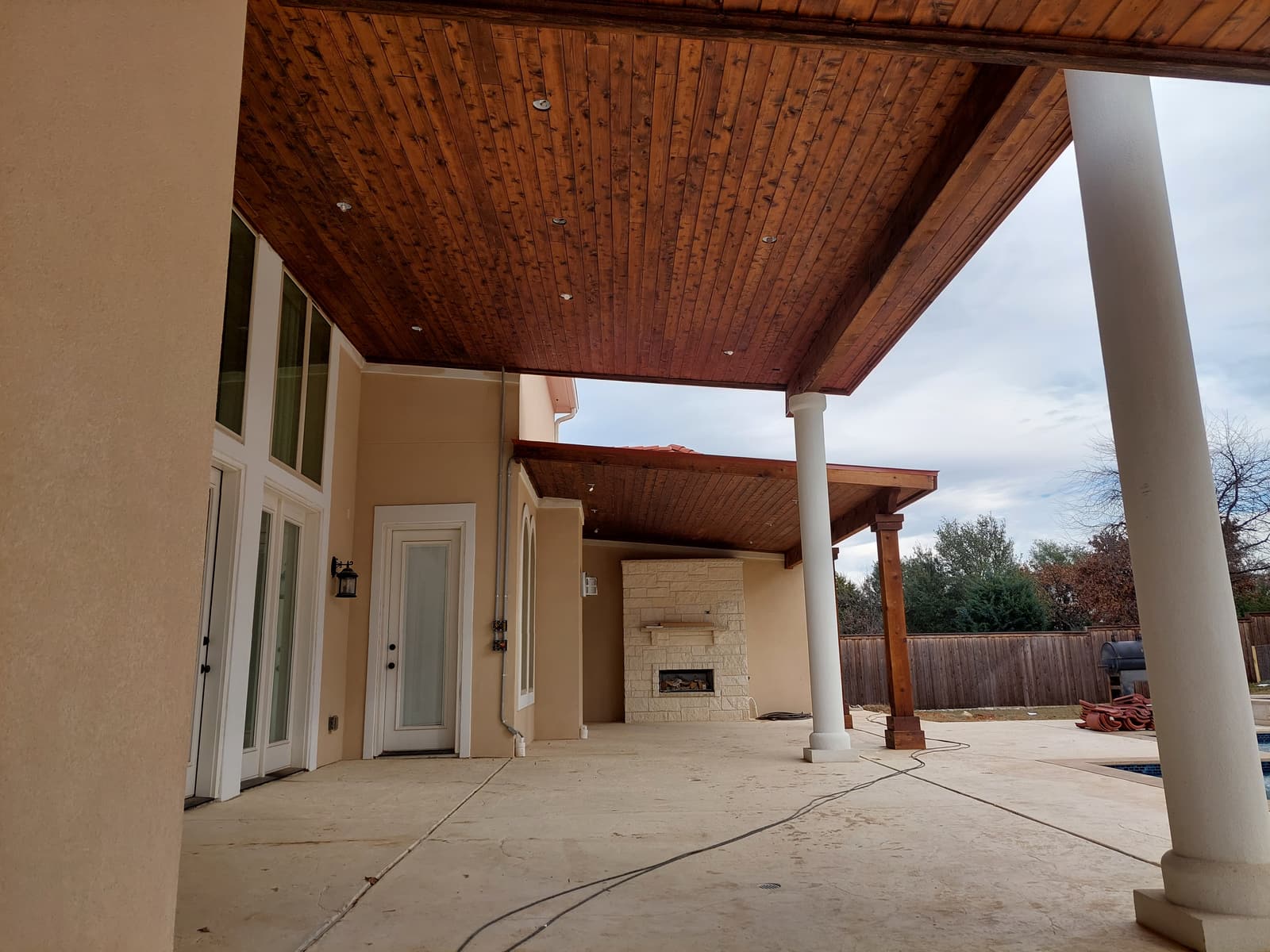
It depends almost entirely on size, roof complexity and ceiling finish. A straightforward attached cover over an existing slab is a very different number than a vaulted structure with an exposed truss, an outdoor kitchen and a stone fireplace. We quote one fixed, itemized number in writing after we walk the space — and we will tell you where you can save money without regretting it.
Can you build over my existing concrete patio?
Usually yes. We core-drill and set footings through the existing slab where the posts land, so the structure bears on soil rather than on your patio. If the slab is cracked, undersized or heaving, we will say so — building a permanent structure on top of a slab that is already failing is throwing money away.
Shingle roof or metal?
Shingles that match your house are the most common choice and they disappear visually, which is often what you want. Standing-seam metal costs more, lasts longer, and looks sharp on a modern structure. Both work. What we will not do is put a corrugated panel over your house and call it done.
Will it make my house darker inside?
It can, and it is worth talking about before we build. A deep cover over south- or west-facing windows cuts a real amount of light. Sometimes the answer is a shallower depth, sometimes it is a pergola section on the end that lets light through, and sometimes the trade is worth it because those rooms were unbearably hot anyway. We will show you the tradeoff on paper first.
Pavilions & Cabanas
About pavilions & cabanas
What is the difference between a pavilion, a gazebo and a cabana?
A pavilion is a freestanding roofed structure that is open on all sides — usually rectangular. A gazebo is the same idea but typically round or octagonal with a railing. A cabana is a pavilion built to serve a pool, usually with one or more solid walls for wind and privacy. We build all three; most people asking for a gazebo actually want a pavilion.
Can I put a pavilion where my yard slopes?
Yes. Slope is a footing and drainage problem, not a dealbreaker. We step the footings, set the posts to a level plane, and make sure water runs around and away from the structure instead of pooling under it. A sloped yard sometimes makes the best site because it gets the structure up where the view is.
How long does a pavilion take?
A freestanding pavilion with a vaulted ceiling and an exposed truss is typically a two to three week build, plus permitting ahead of it. Trusses take longer than they look because we cut and fit them rather than ordering them stamped and stacked.
Outdoor Kitchens
About outdoor kitchens
Can I put a grill under a covered patio?
Yes, if it is done right. You need adequate clearance from the grill to a combustible ceiling, and often a non-combustible surround or a vent hood depending on the appliance and your local code. We size that clearance before we frame the ceiling, not after. If somebody offers to just slide a grill under your existing cover, get a second opinion.
Do I need a permit for an outdoor kitchen?
The gas and electrical work almost always requires a permit and inspection, even when the masonry does not. We pull it. An unpermitted gas line is a problem for your insurance and a problem when you sell the house.
What happens to the plumbing when it freezes?
We install an accessible shutoff and set the lines so they can be drained down, and we show you how before we leave. North Texas gets at least one hard freeze most winters. An outdoor kitchen sink that cannot be isolated and drained is a burst pipe waiting for a cold snap.
Decks & Docks
About decks & docks
How long does a deck last in North Texas?
A properly framed deck lasts as long as its frame — which, with treated lumber, proper flashing and galvanized or stainless hardware, is decades. The decking surface is what wears. Cedar surfaces typically want replacing or serious refinishing somewhere past the ten-year mark depending on exposure and upkeep; quality composite goes far longer.
Can you fix or rebuild my existing deck?
Often, yes — and sometimes we will tell you not to. If the frame is sound and flashed correctly, re-decking is a great value. If the ledger is nailed on and the posts are buried in dirt, patching it is spending good money on a structure we would not let our own family stand on. We will show you what we find and let you decide.
Do you build docks and waterfront structures?
Yes. We have built community docks, lakeside overlooks and amenity decks with curved framing and steel rail, including work built to commercial spec and inspection. Waterfront work has its own permitting and pier requirements, and we handle that.
Commercial
About commercial
Do you work from our engineered drawings?
Yes. Send them and we will bid from them. If you do not have drawings yet, we can design the structure and route it through an engineer for a stamp as part of the project.
Can you hit an amenity opening date?
That is most of why developers call us. We build the sequence backward from your date, order lumber ahead, and coordinate with the concrete and landscape crews so we are not waiting on a pad that is not ready. If a date is not achievable we tell you during the bid, not in month three.
Are you insured for commercial work?
Yes, and we provide certificates of insurance, W-9s and lien waivers on your standard forms as a matter of course.
Free Estimates
Tell us what you want to build.
Nathan will walk your yard, talk through what will actually work, and give you a written number. It costs nothing and there is no obligation on the other side of it.